
Keeping accurate financial records is essential for every business, but bookkeeping can quickly become time-consuming as transactions, invoices and expenses increase.
For small businesses in Croydon, one of the most common questions is: how much does bookkeeping cost, and what should you actually receive for the fee?
The answer depends on the size of your business, transaction volume, bookkeeping frequency and whether you need additional support with VAT, payroll, tax or annual accounts.
Aczone Consultants provides professional bookkeeping services in Croydon and across the UK, helping sole traders, startups and limited companies maintain organised financial records and keep their wider accounting processes running smoothly.
This guide explains typical bookkeeping costs in 2026, what affects pricing, which services may be included and when outsourcing bookkeeping can make sense for your business.
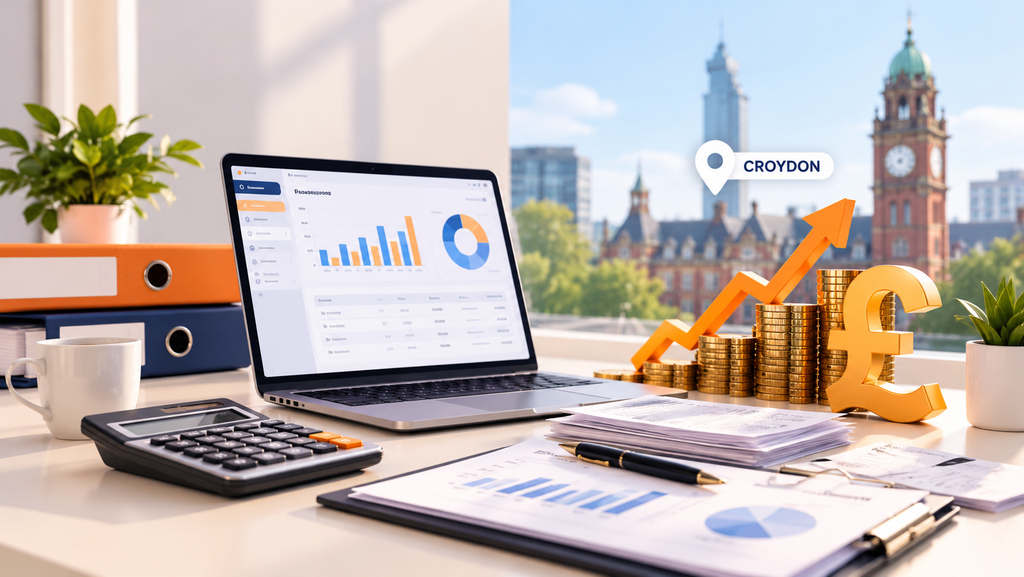
Quick Answer: How Much Does Bookkeeping Cost in Croydon?
Bookkeeping services in Croydon commonly cost around £15 to £50 per hour, depending on the complexity and frequency of the work. Some providers instead offer fixed monthly packages. Businesses with more transactions, VAT requirements, payroll integration or disorganised records will generally require more bookkeeping time and therefore pay more.
What Is Bookkeeping?
Bookkeeping is the process of recording, organising and maintaining a business’s day-to-day financial transactions.
This can include:
- Sales and customer payments
- Business expenses
- Supplier invoices
- Purchase records
- Bank transactions
- Receipts
- Bank reconciliations
- VAT-related records
- Payroll-related information
Accurate bookkeeping creates the financial foundation used for tax returns, annual accounts and business reporting.
HMRC requires sole traders to keep records of business income and expenses, as well as VAT and PAYE records where applicable. These records must be accurate enough to identify business transactions and support tax reporting.
Bookkeeping is therefore not simply administrative data entry. It helps ensure the financial information used by your accountant is complete and reliable.
How Much Do Bookkeeping Services Cost in Croydon in 2026?
Bookkeeping fees vary significantly because every business generates a different amount of financial activity.
Current published UK and Croydon-market guidance indicates that bookkeeping can typically cost around £15–£50 per hour, with more complex requirements potentially sitting toward the higher end of that range.
| Bookkeeping Pricing Model | Typical Position |
| Hourly bookkeeping | Around £15–£50 per hour |
| Fixed monthly bookkeeping | Based on transaction volume and service scope |
| Catch-up bookkeeping | Usually priced according to backlog and complexity |
| Bookkeeping + VAT | Higher than basic transaction recording |
| Bookkeeping + payroll | Depends on employee numbers and frequency |
| Full accounting package | May combine bookkeeping, accounts and tax |
These figures should be treated as general market guidance rather than a fixed Croydon price list.
A business with 30 transactions per month will normally require much less bookkeeping work than a business processing several hundred transactions across multiple accounts.
What Affects Bookkeeping Fees?
Several factors influence the final cost of bookkeeping.
1. Number of Transactions
Transaction volume is one of the biggest pricing factors.
Every sale, expense, bank payment, subscription and supplier invoice needs to be recorded or reviewed correctly.
A small consultancy with limited monthly activity may require relatively little bookkeeping.
An ecommerce business processing hundreds of transactions can require considerably more work.
2. Frequency of Bookkeeping
Some businesses update records monthly.
Others may require bookkeeping every week or even more frequently.
More frequent bookkeeping can provide better financial visibility, but it can also increase the amount of ongoing work involved.
Aczone recommends a bookkeeping frequency based on transaction volume and reporting requirements, with many businesses benefiting from weekly or monthly updates rather than waiting until year end.
3. Condition of Your Existing Records
Well-organised records generally require less corrective work.
Bookkeeping becomes more expensive when:
- Receipts are missing
- Transactions have been duplicated
- Bank accounts have not been reconciled
- Personal and business expenses are mixed
- Several months of records are incomplete
- Previous bookkeeping contains errors
Regular bookkeeping can therefore cost less operationally than allowing a large backlog to build up.
4. VAT Registration
VAT-registered businesses usually require more detailed bookkeeping because transactions need to be recorded correctly for VAT purposes.
The UK VAT registration threshold is currently £90,000 of taxable turnover. Businesses must generally register if taxable turnover over the previous 12 months exceeds this threshold or if they expect to exceed it within the relevant HMRC period.
VAT bookkeeping may involve:
- Correct VAT treatment
- Sales and purchase records
- VAT reconciliation
- Digital records
- Supporting VAT return preparation
This can increase the work required compared with basic bookkeeping.
5. Number of Bank Accounts
A business using several bank accounts, credit cards or payment platforms creates additional reconciliation work.
For example, a company receiving payments through a bank account, Stripe and PayPal may require more processing than a business operating from one account.
6. Payroll Requirements
Payroll information also affects the wider accounting records.
Businesses employing staff may need to coordinate bookkeeping with:
- Salaries
- PAYE
- National Insurance
- Pension contributions
- RTI submissions
Aczone’s Payroll Management Services can be connected with bookkeeping where a business needs both services.
What Is Usually Included in Bookkeeping Services?
The exact scope should always be agreed before appointing a bookkeeper or accountant.
A professional bookkeeping service may include:
- Recording financial transactions
- Categorising income and expenses
- Reconciling bank accounts
- Organising sales records
- Organising supplier records
- Checking invoices and receipts
- Maintaining VAT-ready records
- Preparing bookkeeping information for year-end accounts
- Coordinating records with payroll and tax work
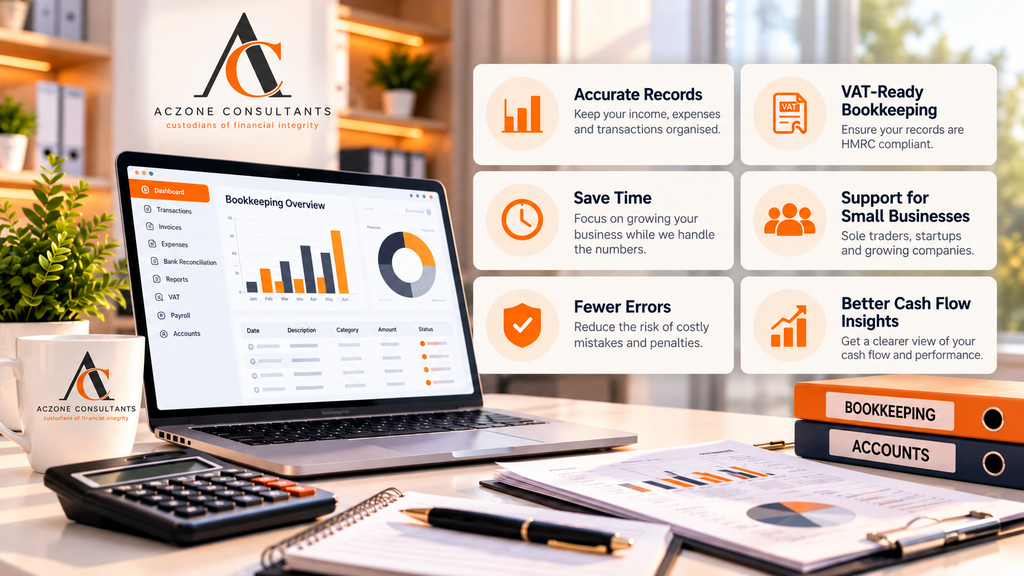
Aczone’s Bookkeeping Services specifically cover transaction recording and categorisation, bank reconciliation, organised purchase and sales records, VAT-ready bookkeeping and year-end preparation support.
Always ask what is included before comparing prices.
Two bookkeeping packages priced differently may actually offer completely different levels of support.
Hourly vs Fixed Monthly Bookkeeping: Which Is Better?
Both pricing models can work.
Hourly Bookkeeping
Hourly pricing may suit businesses that only require occasional support.
For example, a sole trader with a relatively small number of transactions might only require a few hours of bookkeeping periodically.
The disadvantage is that the monthly cost can vary.
Fixed Monthly Bookkeeping
Fixed monthly pricing can be easier for businesses that require regular bookkeeping.
The main advantage is predictable costs.
A fixed package may be based on factors such as:
- Monthly transaction volume
- Number of accounts
- VAT status
- Payroll requirements
- Reporting frequency
Aczone uses fixed monthly fees tailored to the complexity and scope of the client’s requirements. Its wider accounting pricing currently starts from £50 per month for sole traders, although the price of a specific bookkeeping package depends on the work required.
For many small businesses, predictable monthly pricing can make budgeting easier.
How Much Does Bookkeeping Cost for a Sole Trader?
Sole traders often have simpler bookkeeping requirements than larger companies, particularly when transaction volume is low.
Typical bookkeeping may involve:
- Recording sales
- Recording expenses
- Bank reconciliation
- Organising receipts
- Preparing records for Self Assessment
A sole trader can maintain their own bookkeeping if they have the time and knowledge to do so.
However, outsourcing may become worthwhile when bookkeeping begins taking several hours every month or records regularly fall behind.
The real calculation is not only the bookkeeping fee.
Consider the value of the owner’s time.
If a business owner spends six hours every month manually sorting transactions, those six hours could potentially be used for customers, marketing or revenue-generating work.
How Much Does Bookkeeping Cost for a Limited Company?
Limited companies typically have more structured accounting requirements.
Bookkeeping may need to support:
- Annual accounts
- Corporation Tax
- Payroll
- Director transactions
- VAT
- Financial statements
- Companies House reporting
Companies must maintain adequate accounting records, including records of money received and spent and information about assets and liabilities.
This means bookkeeping quality becomes particularly important.
Aczone’s Accounting & Financial Statements service can work alongside bookkeeping so that year-end accounts are based on properly maintained financial records.
How Making Tax Digital Changes Bookkeeping in 2026
Digital bookkeeping has become even more important for some sole traders and landlords.
From 6 April 2026, Making Tax Digital for Income Tax applies to qualifying sole traders and landlords with total qualifying self-employment and property income above £50,000, based on the relevant earlier tax return.
The threshold is scheduled to reduce to more than £30,000 from April 2027 and more than £20,000 from April 2028.
Businesses within MTD for Income Tax need compatible software to maintain digital records and send quarterly updates to HMRC.
For affected sole traders, bookkeeping is therefore becoming more closely connected to ongoing digital tax reporting.
Waiting until January to organise an entire year’s transactions is increasingly impractical.
Bookkeeping vs Accounting: What Is the Difference?
Bookkeeping and accounting are connected but they are not identical.
Bookkeeping records the financial activity. Accounting interprets and reports it.
A bookkeeper may record:
- £2,000 received from customers
- £500 spent on software
- £300 spent on advertising
An accountant can then use those records to prepare accounts, calculate relevant tax figures and review business performance.
For a deeper explanation, read Aczone’s guide: Bookkeeping vs Accounting: What Does a Croydon Small Business Actually Need in 2026?
Many growing businesses eventually need both services.
Can You Do Your Own Bookkeeping?
Yes.
Many sole traders and small business owners manage their own bookkeeping using accounting software.
DIY bookkeeping may work if:
- Transaction volume is low
- Records are straightforward
- You understand the accounting software
- You consistently update the records
- You reconcile the bank regularly
The problem usually begins when bookkeeping is continuously postponed.
A month’s backlog can quickly become six months.
By year end, the owner may no longer remember what individual transactions relate to.
Professional bookkeeping becomes useful when maintaining accurate records internally starts consuming too much time or creating unnecessary risk.
Common Bookkeeping Mistakes Small Businesses Make
Leaving Bookkeeping Until Year End
This is one of the most common mistakes.
Waiting until accounts or tax returns are due makes it much harder to identify missing information.
Better approach: update records monthly or more frequently where appropriate.
Mixing Personal and Business Expenses
Mixed transactions create unnecessary reconciliation work.
Better approach: use a dedicated business account where practical and clearly identify personal transactions.
Not Reconciling the Bank
Having transactions in accounting software does not automatically mean the records are correct.
Better approach: regularly compare the bookkeeping records with actual bank activity.
Losing Receipts and Invoices
Missing supporting documents can create problems when expenses need to be reviewed.
Better approach: use digital receipt storage and establish a consistent filing process.
Assuming Software Does Everything Automatically
Accounting software can automate parts of bookkeeping, but incorrect transaction rules or categorisation can still produce inaccurate records.
Better approach: review the information regularly rather than assuming automation is always correct.
Ignoring VAT Until the Threshold Is Reached
Businesses close to the VAT threshold should monitor taxable turnover rather than discovering too late that registration was required.
Better approach: track turnover regularly and speak to your accountant when the business approaches the threshold.
Is Outsourcing Bookkeeping Worth It?
For many businesses, yes—but it depends on the circumstances.
Outsourcing becomes particularly useful when:
- Bookkeeping is regularly behind
- Transaction volume is increasing
- VAT registration applies
- The business employs staff
- Records are difficult to manage
- The owner needs better cash-flow visibility
- Year-end accounts require extensive corrections
- Too much management time is being spent on administration
The main benefit is consistency.
Regular bookkeeping can give the business a clearer view of income, expenses, outstanding payments and cash flow throughout the year.
This information can also support wider financial planning through Aczone’s Business Consultancy & Financial Advisory service.
Example: Croydon Small Business Bookkeeping
Consider a small Croydon consultancy operating through a limited company.
Each month it has:
- 50 customer and supplier transactions
- One business bank account
- Several software subscriptions
- Director expenses
- Payroll for two employees
If the director handles everything personally, the bookkeeping may take several hours every month.
As the company grows, transaction volume could double.
At that point, outsourcing bookkeeping may allow the director to spend more time dealing with clients while the financial records remain organised.
The decision should therefore consider both bookkeeping cost and management time.
How to Choose a Bookkeeper in Croydon
Do not choose a bookkeeping service purely because it has the lowest price.
Before appointing someone, ask:
- What is included in the fee?
- Is pricing hourly or fixed monthly?
- How frequently will the records be updated?
- Who will reconcile the bank accounts?
- Can you work with our existing accounting software?
- Can you support VAT-registered businesses?
- Can bookkeeping integrate with payroll?
- Can you also prepare annual accounts and tax returns?
- Who will be our main contact?
- What information do you need from us each month?
The answers will help you compare the actual service rather than just the headline price.
Why Use a Local Bookkeeping Service in Croydon?
Cloud accounting means a business can work with a bookkeeper almost anywhere.
However, many small businesses still value having local support.
Working with a Croydon accounting firm can provide:
- Access to face-to-face meetings
- Local business familiarity
- Easier ongoing communication
- Bookkeeping connected with wider accounting services
- A consistent point of contact
Aczone Consultants is based at 131 South End, Croydon, CR0 1BJ and supports businesses in Croydon, South London and across the UK.
How Aczone Consultants Can Help
Aczone provides structured bookkeeping support for businesses that want accurate, regularly maintained financial records.
The service can include:
- Transaction recording and categorisation
- Bank reconciliation
- Sales and purchase records
- VAT-ready bookkeeping
- Year-end preparation
- Coordination with payroll
- Coordination with accounting and taxation
Where required, bookkeeping can also connect with Aczone’s Taxation Services, Payroll Management Services and Accounting & Financial Statements.
This joined-up approach can reduce duplicated work and make it easier to keep financial information consistent throughout the year.
Frequently Asked Questions
How much does a bookkeeper cost per hour in Croydon?
Published market guidance suggests bookkeeping commonly costs around £15–£50 per hour, depending on complexity and service requirements.
Is monthly bookkeeping cheaper than hourly bookkeeping?
Not necessarily. However, fixed monthly packages can provide more predictable costs for businesses requiring regular bookkeeping.
How often should bookkeeping be done?
It depends on transaction volume. Smaller businesses may be able to update records monthly, while businesses with higher transaction volumes may benefit from weekly updates.
Can I do my own bookkeeping?
Yes. Many sole traders and smaller businesses manage their own records. Professional support becomes useful when bookkeeping takes too much time, becomes inconsistent or the business grows more complex.
Does bookkeeping include VAT returns?
Not always. Some bookkeeping packages include VAT-ready records or VAT support, while others charge separately. Confirm the scope before appointing a provider.
Does bookkeeping include payroll?
Usually not automatically. Payroll is often a separate service, although the two should work together because salary, PAYE and National Insurance information affects the accounts.
Do limited companies need bookkeeping?
Limited companies need adequate accounting records. Regular bookkeeping is the practical process used by many companies to maintain those records and prepare for annual accounts and tax reporting.
Does Making Tax Digital Affect Bookkeeping?
Yes for businesses within the MTD rules. From April 2026, qualifying sole traders and landlords above the relevant income threshold must maintain digital records using compatible software and provide quarterly updates to HMRC.
Can the same firm handle bookkeeping and accounting?
Yes. Using the same firm for bookkeeping, annual accounts and tax can create a more consistent process because the accountant already has access to the underlying financial records.
Final Thoughts
The cost of bookkeeping in Croydon depends on how much work your business actually requires. Transaction volume, VAT registration, payroll, bookkeeping frequency and the quality of existing records can all affect the final fee.
While published market rates commonly fall between £15 and £50 per hour, price alone should not determine which bookkeeping service you choose. The bigger question is whether the service keeps your records accurate, saves management time and makes tax, payroll and year-end accounting easier.
For sole traders, startups and limited companies that want ongoing support, Aczone Consultants provides professional bookkeeping services in Croydon with fixed pricing tailored to the agreed scope of work. If you want to understand what level of bookkeeping your business needs, contact Aczone Consultants to discuss your current records and requirements.