
Starting a limited company is an important step for any entrepreneur. It can give your business a clearer legal structure, support future growth and create separation between the company and its owners. However, registering a company is only the beginning.
In 2026, new directors also need to think about Companies House requirements, identity verification, bookkeeping, Corporation Tax, annual accounts, payroll, VAT and ongoing financial records.
For anyone starting a limited company in Croydon, getting these foundations right from the beginning can save considerable time and prevent costly administrative problems later.
Aczone Consultants provides professional Business Setup & Company Formation support for startups and established businesses in Croydon and across the UK, connecting company registration with the accounting systems a business needs once it starts trading.
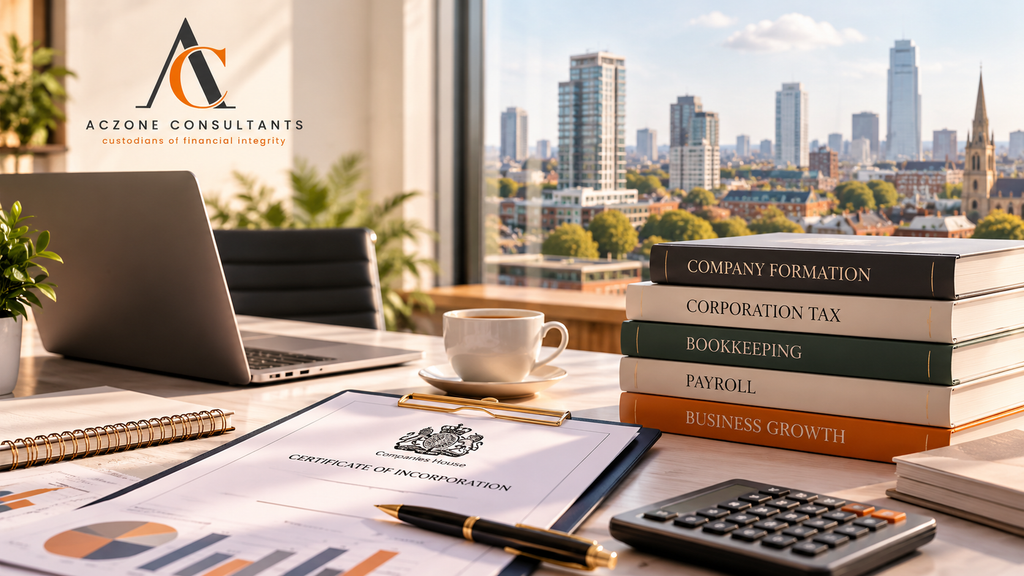
What Is a Limited Company?
A limited company is legally separate from the people who own and manage it.
This distinction is important. Once a company is incorporated, business income, expenditure, assets and liabilities belong to the company rather than directly to the director.
That means directors need to treat company finances differently from personal finances.
A limited company may also have responsibilities relating to:
- Companies House filings
- Corporation Tax
- Annual statutory accounts
- Confirmation statements
- Accounting records
- Payroll
- VAT, where applicable
- Workplace pensions, where applicable
The structure can work well for many businesses, but it creates more administration than operating as a straightforward sole trader.
Before incorporating, it is worth considering whether a limited company is genuinely the right structure for your circumstances.
How Do You Register a Limited Company in the UK in 2026?
A private limited company is registered with Companies House.
The current online Companies House incorporation fee is £100, and Companies House states that online applications are usually processed within 24 hours. Successful registration results in a certificate of incorporation showing that the company legally exists.
During the registration process, you will normally need to provide information including:
- Company name
- Registered office address
- Director details
- Shareholder details
- People with significant control
- Share structure
- Business activity information
The process may look straightforward, but decisions made at incorporation can affect the way the business operates later.
Aczone’s Company Formation and Business Setup service combines registration support with initial accounting, bookkeeping, tax and payroll setup so the financial side of the business is considered from day one.
Identity Verification for Company Directors in 2026
Companies House identity verification is now an important part of the company-registration environment.
New directors may need to verify their identity and obtain a unique Companies House personal code. Where a company has multiple directors, each director may need their own personal code during the registration process.
This means anyone planning company formation in Croydon should consider identity verification before leaving incorporation until the last minute.
The personal code is linked to the individual rather than a specific business and should be stored securely.
Sole Trader or Limited Company: Which Is Better?
There is no structure that is automatically right for every business.
A sole trader structure is generally simpler to administer. A limited company creates a separate legal entity and brings additional accounting and reporting requirements.
Before deciding, consider:
- Expected income and profitability
- Commercial risk
- Number of owners
- Future investment plans
- Whether you intend to employ staff
- Administrative workload
- Accounting requirements
- How you intend to take money from the business
- Long-term growth plans
The decision should not be made solely because someone says a limited company will automatically save tax.
Tax outcomes depend on individual circumstances and current legislation.
A professional accountant in Croydon can help you consider the practical differences before the business structure is finalised.
Open a Separate Business Bank Account
One of the first practical steps after incorporation should be separating company finances from personal finances.
A limited company is a separate legal entity, so its financial records should clearly show money entering and leaving the business.
Using a dedicated business bank account makes it easier to identify:
- Customer payments
- Supplier payments
- Business expenses
- Director contributions
- Director withdrawals
- Payroll payments
- Tax payments
Mixing personal and company transactions can make bookkeeping unnecessarily complicated and create confusion when year-end accounts are prepared.
Clear separation makes the financial records easier for both the director and accountant to understand.
Set Up Bookkeeping from Day One
New companies often focus on winning customers first and leave bookkeeping until later.
This is one of the easiest ways to create unnecessary accounting work.
Every business transaction contributes to the company’s financial records. If transactions are not organised as they occur, directors may eventually need to reconstruct months of activity from bank statements and old invoices.
Good bookkeeping should normally include:
- Recording sales
- Recording purchases and expenses
- Saving invoices and receipts
- Categorising transactions
- Reconciling bank accounts
- Tracking amounts owed by customers
- Maintaining supplier records
- Keeping financial documents organised
Aczone provides professional Bookkeeping Services in Croydon that integrate with tax, payroll and year-end accounting requirements.
Starting with an organised bookkeeping system is generally far easier than correcting incomplete records at the end of the year.
Keep Your Accounting Records Properly
Limited companies are required to maintain accounting records showing money received and spent, along with supporting information such as invoices, contracts and bank statements.
In many cases, company accounting records must be retained for at least six years from the end of the financial year they relate to, although longer retention can apply in certain circumstances.
That makes document management an important part of the financial setup.
Digital accounting software can make this easier, particularly when it is connected to business banking and supported by consistent bookkeeping processes.
Understand Your Corporation Tax Responsibilities
Corporation Tax is separate from a director’s personal tax position.
A limited company generally pays Corporation Tax on taxable company profits.
When a company is registered through the standard Companies House service, it will usually also be set up for Corporation Tax unless the company is dormant. Once the company’s Unique Taxpayer Reference is received, Corporation Tax services can be added to the business tax account.
The important point is that HMRC does not simply send a normal tax bill telling the company what it owes.
The company’s accounts and tax calculations need to establish the Corporation Tax position.
Aczone’s Taxation Services include Corporation Tax preparation alongside VAT, Self Assessment and wider tax support.
Know the Corporation Tax Deadlines
Corporation Tax has separate payment and filing deadlines.
For many companies, Corporation Tax is normally payable nine months and one day after the end of the accounting period, while the Company Tax Return is normally due 12 months after the end of the accounting period.
These two deadlines are easy for new directors to confuse.
The tax usually needs to be paid before the Company Tax Return filing deadline.
New companies can also have slightly more complicated first accounting periods because Companies House accounts and Corporation Tax periods do not always cover exactly the same dates during the first year.
This is one reason early accounting setup matters.
Prepare for Annual Accounts
A private limited company needs to prepare statutory annual accounts.
These accounts provide information about the company’s financial performance and financial position.
For an established private company, annual accounts are normally due at Companies House nine months after the company’s financial year ends. First accounts can have different deadlines; Companies House states that a private company’s first accounts are commonly due 21 months after incorporation.
The information required for annual accounts comes directly from the company’s bookkeeping and underlying financial records.
That is why year-end accounts should not be treated as a completely separate process that begins shortly before the filing deadline.
Aczone’s Accounting & Financial Statements service supports businesses with year-end accounts, profit and loss reporting, balance sheets and coordination with Corporation Tax work.
Do Not Forget the Confirmation Statement
Annual accounts and Corporation Tax are not the only recurring filing requirements.
Companies also need to deal with their Companies House confirmation statement.
The confirmation statement is used to confirm that important information Companies House holds about the company remains correct.
The review period normally ends 12 months after incorporation for the first statement, or 12 months after the previous confirmation-statement date. Companies House currently allows a further 14 days to file after the review period ends.
New directors should therefore maintain a basic compliance calendar covering accounts, tax and Companies House filings rather than relying on memory.
Does Your New Company Need Payroll?
If the company starts paying directors or employees through payroll, PAYE and payroll reporting may become relevant.
Payroll can include:
- Salary calculations
- PAYE
- National Insurance
- Payslips
- RTI submissions
- Employee records
- Starters and leavers
- Statutory payments
Incorrect payroll setup can create problems later, particularly if salary payments are made before the correct process has been established.
Aczone’s Payroll Management Services provide support with payroll calculations, PAYE, National Insurance, RTI submissions and related administration.
What About Workplace Pensions?
Companies employing eligible workers may also have workplace pension responsibilities.
Eligible employees generally need to be automatically enrolled where the relevant age, earnings and working-location criteria are met. GOV.UK currently lists automatic-enrolment criteria including workers aged between 22 and State Pension age who ordinarily work in the UK and earn at least £10,000 per year.
Director-only companies can have different circumstances, so directors should not assume that every company automatically has identical pension obligations.
Once employees are involved, pension duties should be reviewed properly.
Aczone provides Pension & Auto-Enrolment Support alongside payroll services.
When Does a Limited Company Need VAT Registration?
VAT registration is another important area for growing businesses.
For 2026/27, the UK VAT registration threshold remains £90,000 of taxable turnover. A business generally needs to register if taxable turnover over the previous 12 months exceeds the threshold, or if it expects to exceed the threshold within the relevant forward-looking period under HMRC’s rules.
New companies should monitor turnover continuously rather than checking only at year end.
Crossing the VAT threshold can affect:
- Pricing
- Customer invoices
- Bookkeeping
- Cash flow
- Accounting software
- VAT returns
Good bookkeeping makes the transition to VAT registration substantially easier.
Should You Hire an Accountant When Starting a Company?
There is no general rule requiring every new company to employ an accountant.
However, directors remain responsible for the company’s accounting, tax and filing obligations whether they perform the work themselves or appoint a professional.
For many founders, professional accounting support becomes valuable because company formation is only the first step.
A startup accountant in Croydon can potentially help coordinate:
- Company setup
- Bookkeeping
- Annual accounts
- Corporation Tax
- Payroll
- VAT
- Director-related accounting
- Financial reporting
- Business planning
The benefit is not simply outsourcing forms.
A structured accounting system also gives the director better financial information throughout the year.
Common Mistakes New Limited Companies Make
Mixing Business and Personal Spending
This makes the accounting records harder to understand and creates additional work around director transactions.
Ignoring Bookkeeping Until Year End
Waiting several months can result in missing invoices, forgotten expenses and unreconciled bank transactions.
Confusing Tax Payment and Filing Deadlines
Corporation Tax payment and Company Tax Return filing have different deadlines.
Forgetting Companies House Filings
Annual accounts and confirmation statements are separate compliance requirements.
Registering for VAT Too Late
Businesses should monitor taxable turnover as they grow.
Setting Up Payroll After Payments Have Already Started
Payroll should ideally be considered before regular salary payments begin.
Choosing a Business Structure Only for Tax Reasons
Company structure affects administration, reporting, ownership and risk as well as taxation.
Limited Company Setup Checklist for 2026
Before your new company becomes fully operational, check that you have covered these areas:
- Confirm that a limited company is the right structure.
- Complete any required identity verification.
- Register the company correctly with Companies House.
- Store the certificate of incorporation and company information securely.
- Open a dedicated business bank account.
- Set up bookkeeping and accounting software.
- Create a reliable invoice and receipt-management process.
- Understand Corporation Tax responsibilities and deadlines.
- Record the annual accounts filing deadline.
- Record the confirmation statement date.
- Set up payroll before paying salaries where required.
- Review pension auto-enrolment obligations if employing staff.
- Monitor taxable turnover for VAT purposes.
- Decide what accounting work will be handled internally and what will be outsourced.
Why Good Accounting Matters Beyond Compliance
Accounting should not only help a business avoid missed deadlines.
Organised financial information helps directors understand what is actually happening inside the company.
Reliable records can answer practical questions such as:
- Is the company profitable?
- How much cash is available?
- Which expenses are increasing?
- How much do customers owe?
- What tax liabilities may be approaching?
- Can the business afford another employee?
- Is growth actually improving financial performance?
As the company grows, these questions become increasingly important.
Businesses requiring deeper support can also use Aczone’s Business Consultancy & Financial Advisory service for financial planning, forecasting and performance analysis.
Frequently Asked Questions
How much does it cost to register a limited company in the UK in 2026?
Companies House currently charges £100 for online company incorporation. Online applications are usually processed within 24 hours.
Do I need an accountant to start a limited company?
Not necessarily. You can form and operate a company without appointing an accountant, but directors remain responsible for accounts, tax and company compliance.
When are a new company’s first accounts due?
For many private limited companies, the first Companies House accounts deadline is 21 months after incorporation.
When is Corporation Tax due?
For many companies, Corporation Tax is normally payable nine months and one day after the end of the accounting period. The Company Tax Return normally has a later deadline of 12 months after the accounting period ends.
What is the VAT registration threshold in 2026?
The UK VAT registration threshold for 2026/27 is £90,000 of taxable turnover.
Should bookkeeping start immediately?
Yes. Maintaining organised records from the first transaction makes annual accounts, tax calculations and financial reporting significantly easier.
Final Thoughts
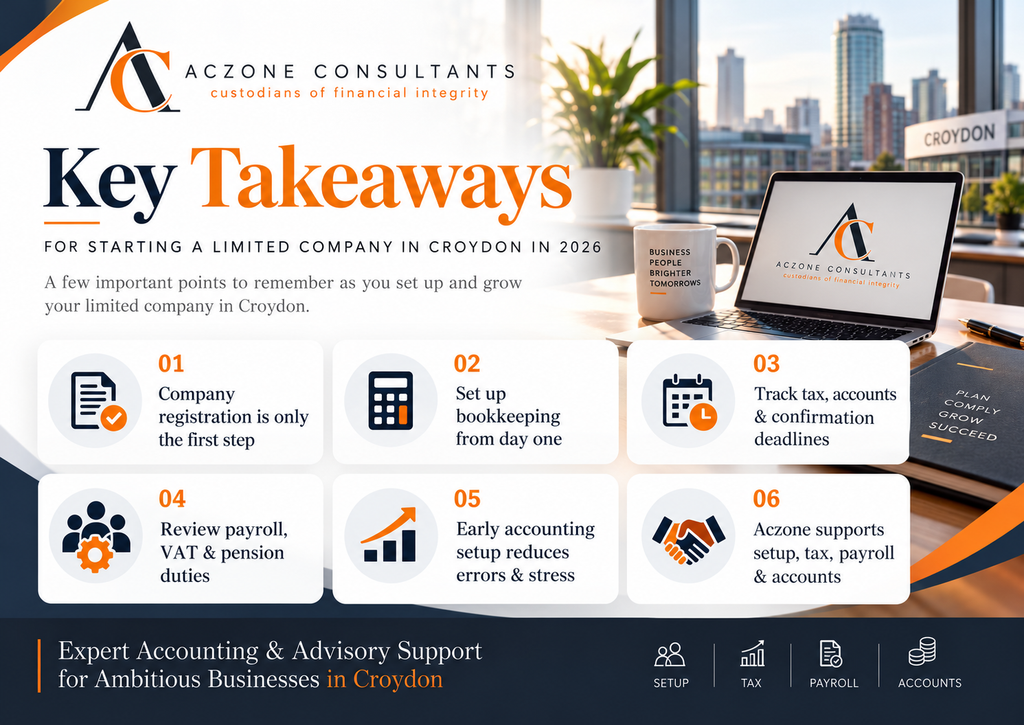
Starting a limited company in Croydon in 2026 involves much more than registering a name at Companies House.A properly structured business also needs reliable bookkeeping, clear accounting records, awareness of Corporation Tax deadlines and appropriate systems for payroll, VAT and Companies House compliance where relevant.
Building these systems early gives directors better control over the business and reduces the risk of turning year-end accounts into a last-minute exercise. Aczone Consultants supports startups and established companies with company formation and business setup, bookkeeping services, accounting and financial statements, taxation support and payroll management in Croydon and across the UK.